
Sample deliverable
This is what our discovery leaves behind.
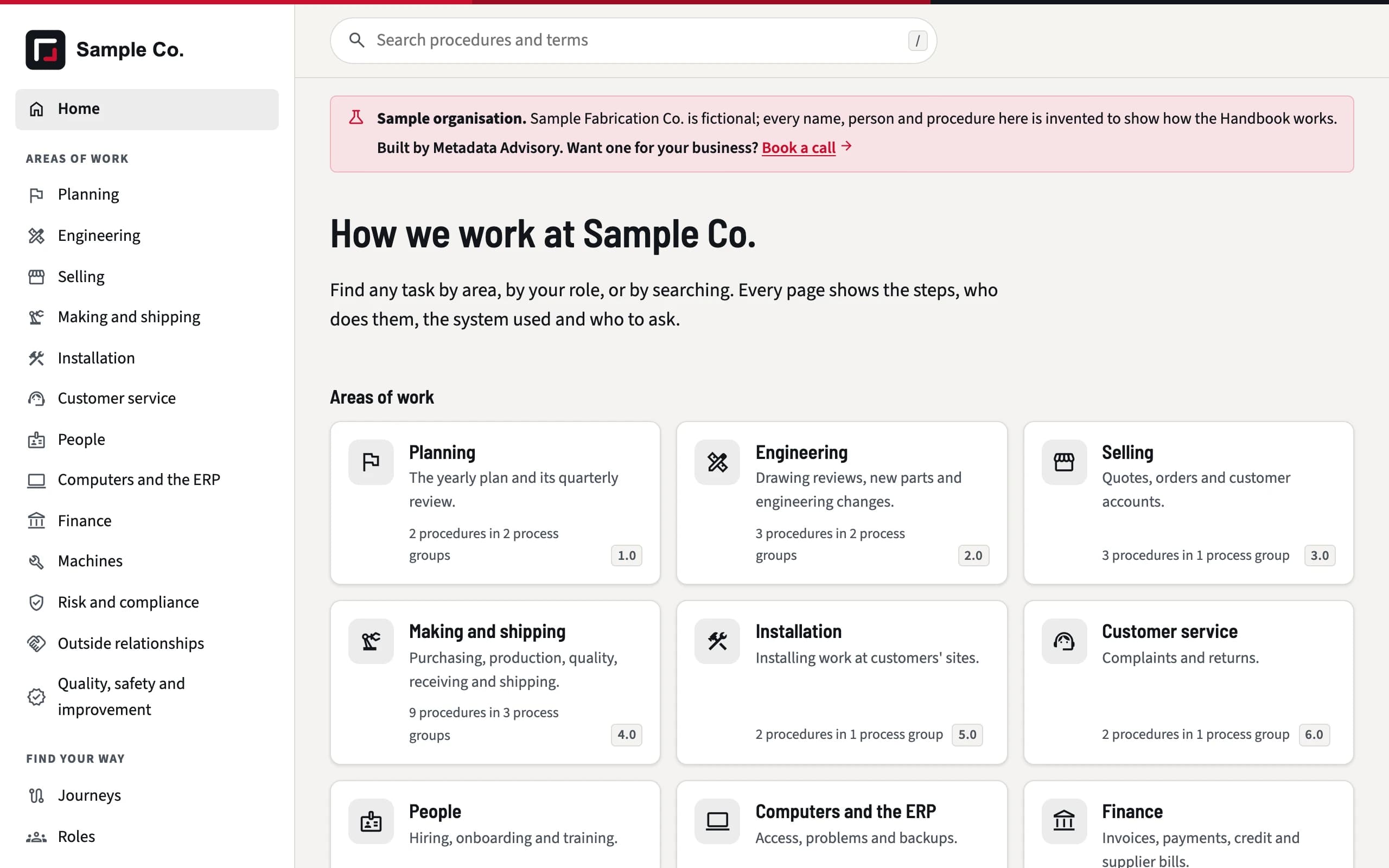
A Handbook your whole team can use: every task, who does it, the system it runs in and who to ask. Here is one we built for a sample company. Look through it below, or ask for a sign-in and explore it yourself.
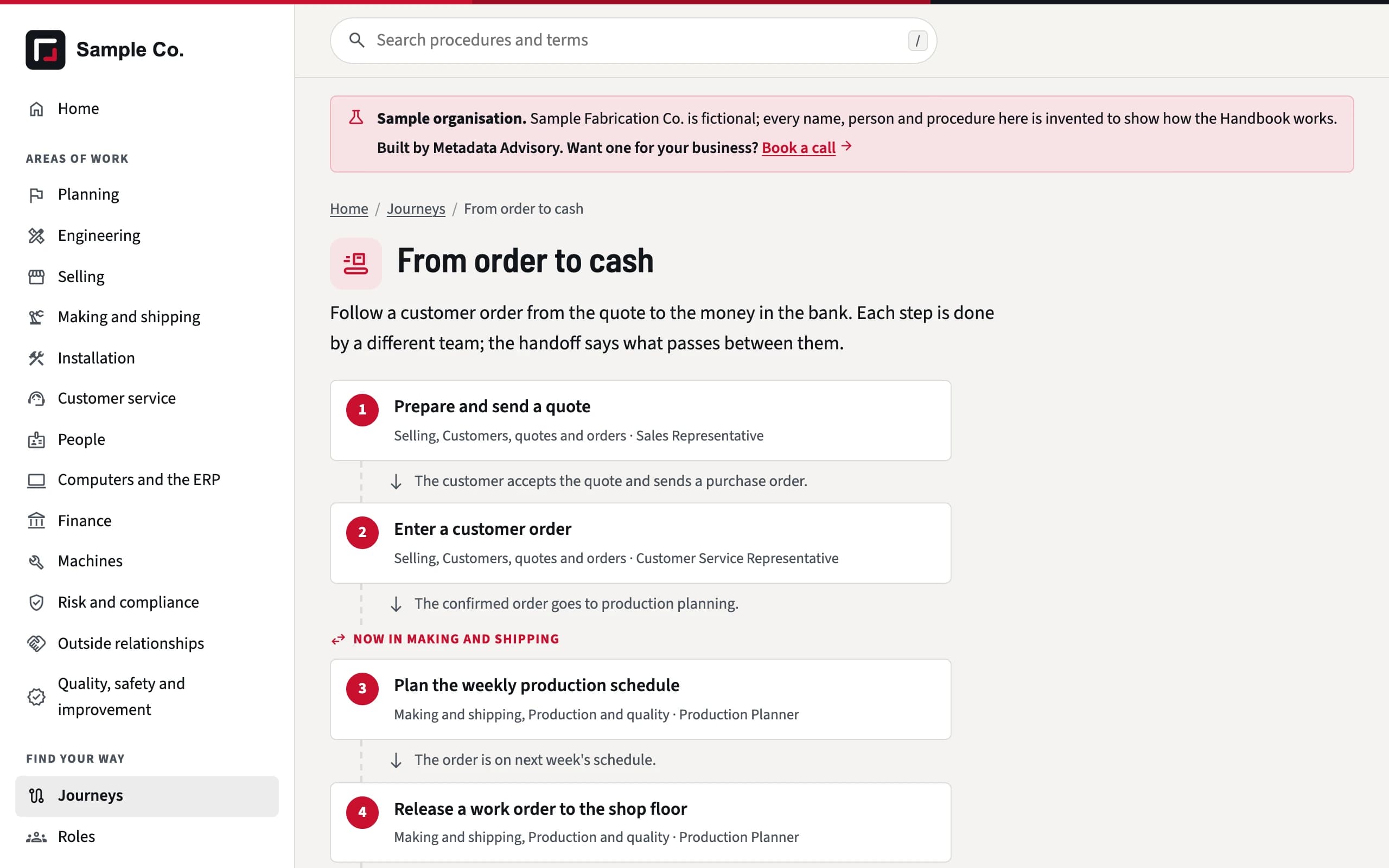
- Areas of work
- 13
- Procedures
- 47
- Start-to-finish journeys
- 5
- Systems mapped
- 8
- Company
- Fictional, for show
- Ask how an order gets shipped and you get three different answers
- New hires learn by shadowing whoever has time
- One or two people hold the whole operation in their heads
- You are looking at new software, and nobody has written down what it must do
Most of how a business runs is never written down.
It lives in people’s heads, old emails and spreadsheets only one person understands. That works until someone leaves, the business grows, or you need to tell a software company what you need. The Handbook puts it in one place your team can read.
Every task, step by step.
Each procedure lists the steps, who does each one and the system it happens in. It also covers what to do when something is different, and who owns the work. Every change is dated and confirmed by the person responsible.
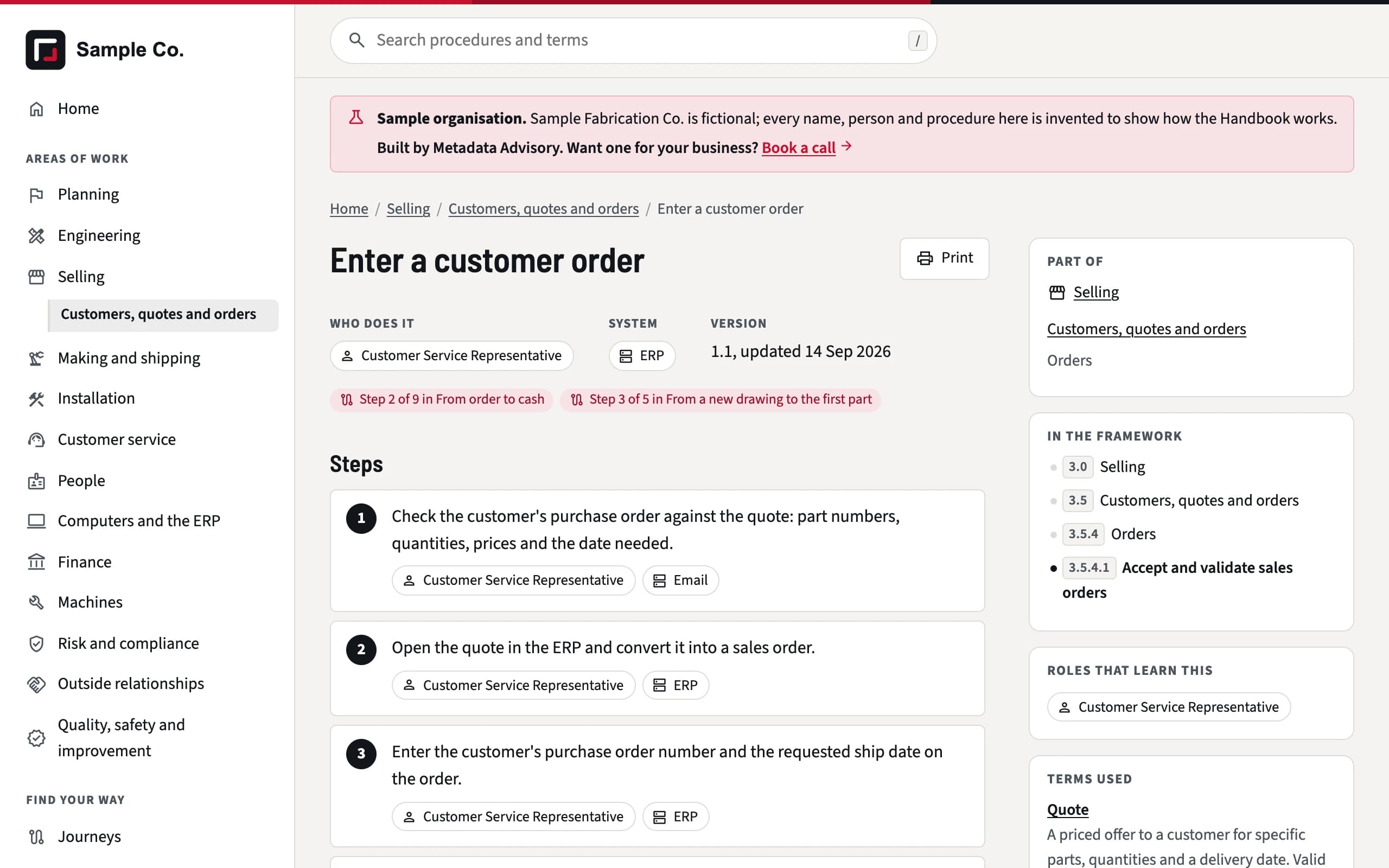
A reading list for every role.
A new hire opens their role and sees the procedures to read, in order. The same page names their backup and who to go to when they are stuck. Know-how stops living in one person's head.
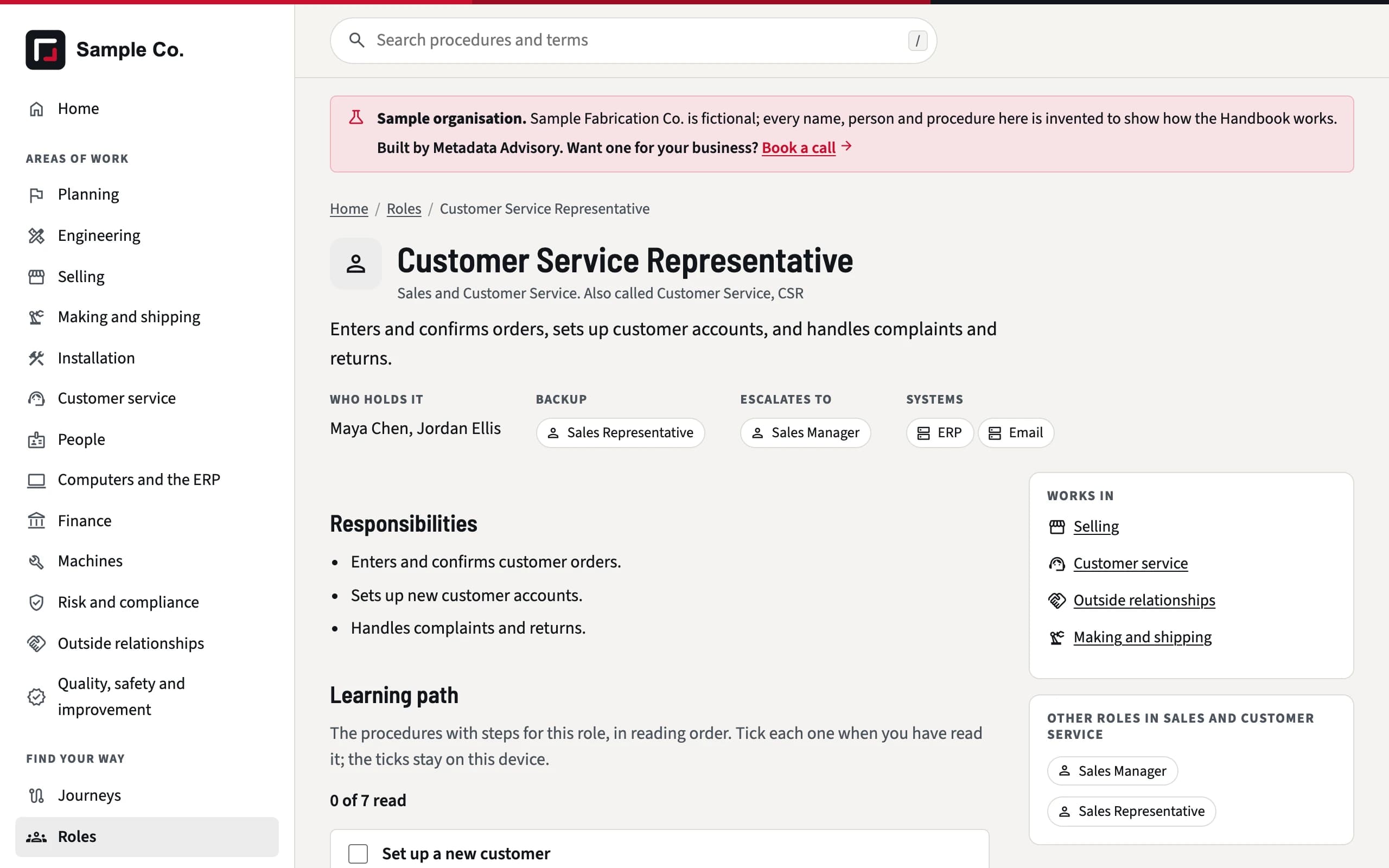
Where your work actually runs.
Each system shows how many steps depend on it. In this sample, 69 steps run in the ERP, 44 in email and 24 on a shared drive. If you go shopping for new software, this is the start of your list of what it must do.
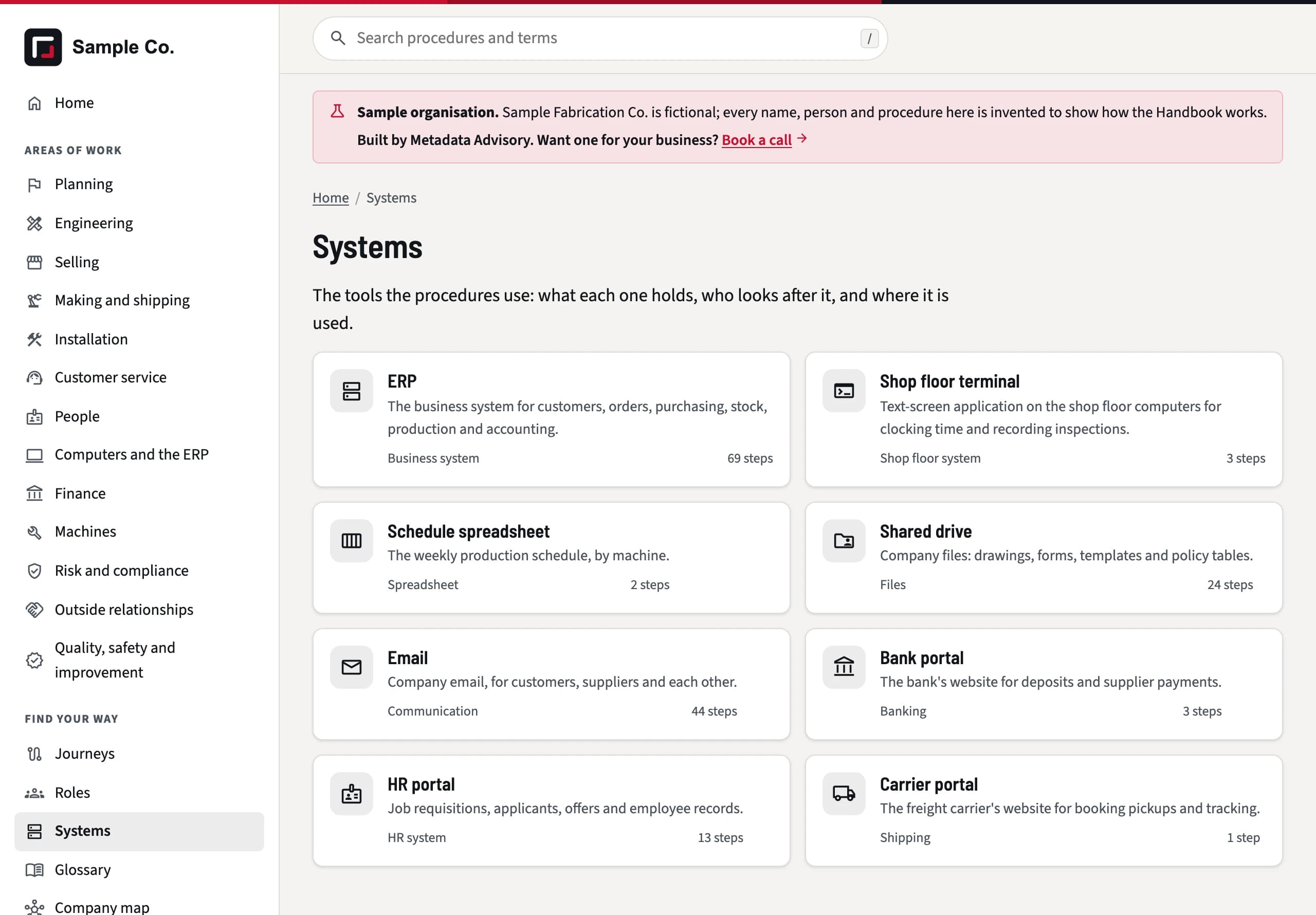
Your team finds any task in seconds.
By area of work, by role, or by searching. Every procedure also sits in the APQC Process Classification Framework, a standard map of business processes, so gaps are easy to spot.
Built with your team, not for it.
The Handbook comes out of the first step of our work: understanding how the business really runs. Your team spends a few hours each. We do the writing.
- 01
We talk to the people who do the work
A kickoff with leadership, then two to three hours with each process owner. We ask how the work really gets done, including the workarounds.
- 02
We write it down in plain language
We do the writing. Steps, roles, systems, handoffs and exceptions, in the words your team already uses.
- 03
Your team confirms it
The person responsible for each procedure checks it before it is published. From then on, each change is dated and confirmed the same way.
Is Sample Co. a real company?
No. Sample Fabrication Co. is invented, and so is every name, person and procedure in it. We built it the same way we build a client's Handbook, so you can see the real thing without seeing anyone's private information.
Would our Handbook look like this?
Same structure, built around your business: your areas of work, your roles, your systems and your words. It covers the parts of the business we agree to map with you.
Where does the Handbook come from?
It is what our discovery work leaves behind, the first step of how we work. It is also the base for everything after: weighing the options, and choosing a system on your terms if you need one.
What does it cost?
The Handbook is part of our discovery work, which has a fixed fee based on the size of your business. We cover it on the first call.
What happens to the details I give you?
We use them to send your sign-in, and we may follow up once to ask what you thought. We never share them with software companies.
Explore it yourself
Open the full Sample Co. Handbook.
Tell us who you are and we will email you a sign-in. Follow a journey from order to cash, search for a task, open a role’s reading list, or see the whole company on one map.
Rather talk it through? Book a call